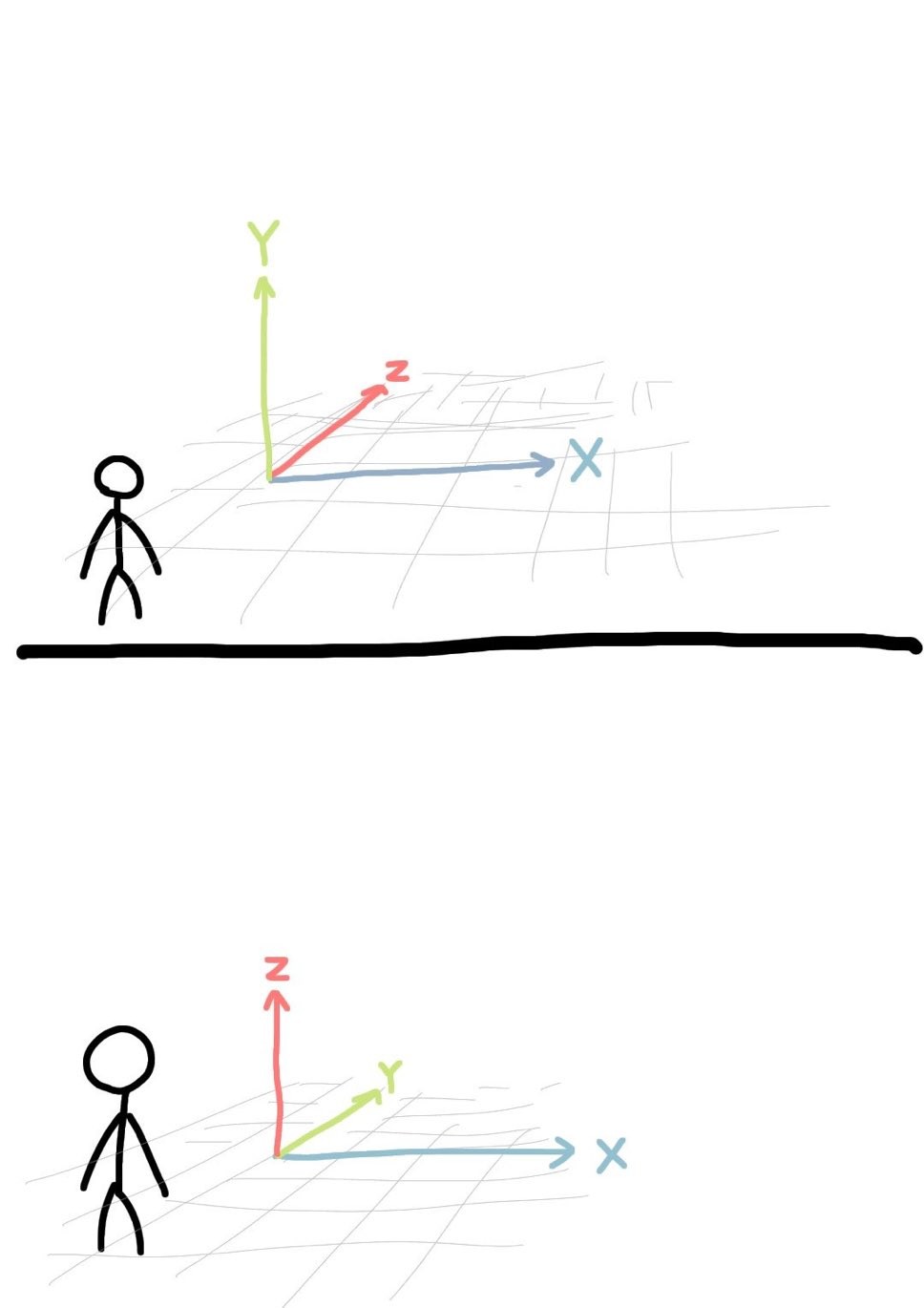

There are others, where there are way more arrows, and they are not at all orthogonal…
I’ll leave this here for context (bottom right is the only sane one)

Minecraft being the most influential of them all
For me it’s the top one. In a web browser, when using CSS and JavaScript, x is the horizontal axis, y is the vertical axis, and z is for depth. Hence the
z-indexCSS property which determines depth.I would say the bottom one only makes sense if the stick figure were to hover in the air and look downwards. Then the z axis would be depth for him.
Z is elevation. Any real world application, z goes up down. 3D applications SHOULD use it for elevation. I despise that many do not. It’s so fucking confusing. 2D, sure y go brrr. But once that 3rd dimension is added, y needs to take several seats and quit trying to take on dimensions it doesn’t have any right to.
Y-up sorta makes sense in games. Imagine a 2D platformer, Y is up and X is horizontal. Now add depth. Instead of flipping axis just use Z for depth.
But in top down 2D games you also use X and Y but now neither is up
True but I think it’s also because of screen coordinates, Y is always the vertical axis in screen coordinates. So programmers translated that to 3D coordinates because in real world space the screen doesn’t lie flat but is up right. It’s probably why Y is up in OpenGL and calls the depth buffer the Z-Buffer.
That’s the core of my point though. Once you add depth it’s not 2d space anymore (even though the screen is 2d, the represented field is 3D) and y becomes depth.
It all depends how you perceive the XY plane. Like if your job involves blueprints than XY plane lies flat and horizontal then it makes sense that Z axis is height. Hence why engineering software is all Z-Up. If the XY plane is upright, like screen coordinates, then Z is depth. Hence why many software that is used to create content for the screen is Y-Up. Like Maya, Houdini, Unity, OpenGL etc.
It makes more sense if you’ve ever drawn in CAD. Top view, x and y. Now side view, y and z or y and x. You look down on x and y, and if you are extruding you now create the z axis dimensions. For the people who draft on the side axis: you are true psychos (ok, unless you’re using a lathe I suppose, or if the silhouette is more defined from the side… ok maybe not psycho, just odd)
I do use CAD software but always have my items resting on an x/y plane with z being height. I do some 3d printing and basic cad designs, so z being elevation still makes sense there.
User look sideways at item on shelf. Designers look down on paper. Both viewpoints are needed for it to be a good object.
Architects do both because they have all that math and something serious to prove.
You convinced me. Have an internet point.
Lol I was just ranting into the void but glad it resonated for you.
Z is depth, full stop, and I have my fists raised, Queensbury-style, to anyone who contends otherwise.
deleted by creator
Neither of these are right. X is forward, Y is to the right and Z is down.
Source: https://iansguides.com/tutorials/aircraft-coordinate-system-and-anatomy/
X is up, there now no one is happy.
I’m came here to talk shit about y-up but now I’m mad at you instead.
There are people who use the top way? WTF?
Minecraft ;)
Technically no, top is right handed but Minecraft uses left handed. Unity, however, is left handed and uses z as up
No Unity uses Y as up. Unreal uses Z as up
Printers
Right handed and left handed? (Top image doesn’t follow right hand rule, Z should point towards camera)
They said “people,” not left handed.
Above and below the page/plane is the z-axis.
But some people “hold” the page up in front of them, or down on the table.
My “page” is my monitor’s screen, a window into many virtual worlds that extend past the plane of my screen.
Actually, my screen is a curved surface. So the 3d virtual world is projected onto a 2d plane which is then projected back onto a 3d curved screen. The math to make it look correct in the final projection is different from what makes it look correct on a flat screen, though I don’t know if any renderers actually do this correction. Not that I think the difference is huge.
No, there are 3 actually:

damn Australians
I use all of them depending on what the coordinates are representing…
ah yes the correct way and the Minecraft way
I clicked on this post to say Y is always elevation because I grew up playing Minecraft.
The top one is wrong because it violates the right hand rule.
Z should be inverted in the top picture.
Agreed. That would be totally valid.
go home programmer, math does not need you!
What about the left hand rule?
Vector mathematics as we use it and code it is based on the right hand rule.
Giggety
Weird didn’t everyone learn XY on paper on a desk first? All they did was add z axis to that original concept for elevation which gives us the bottom image.
Top image is like if I held paper straight parallel to my face.
Screens vs paper. It’s why all the engineering software uses Z-up, since they came from a paper top-down view workflow. But many of the creative software uses y-up, since they exist to create art that gets consumed on a screen. Like animation and games.
Blender and UE4 uses z as up. Which was intuitive to me having been taught that in school but Looks like industry standard for 2d focused engines use Y up based on this comment from 2009. What a mess.
Maya and Unity both use the lefthand axis system which has Y as world up. Max is the one of the few that uses Z as up (DOH!!)
2022 comment:
Maya is fully able to translate between its own (Y up) and UE4’s (Z up) on export, so you can work “upright” in both without any alterations.
didn’t everyone learn XY on paper on a desk first?
No. I was plugging in crazy combinations of r, theta, x, y, z, t, and anything else shown in the built-in demo of that old Mac 3D graphing calculator app years before my teachers got to explaining coordinate systems. I had no idea what most of it meant, but I could make cool looking animated graphics as a third grader…
Also, I found GameMaker which introduced me to using X to the right and Y down in 2D (with the origin in the top-left corner) before algebra was taught to me in school…
Epic mate
When working in 2 dimensions with gravity, it is common to treat Y as up. E.g, 2d video games, physics problems, computer screens.
That’s basically what it comes down to: Is your XY plane a piece of paper that you look at from the top, or is it the pixel coordinates of the screen you are looking through?
That’s why X is usually not contested, because it’s the same on a piece of paper that you view top-down and on a screen that you view from the front.
Y is then one of the two potential axies for either a top-down or a side-scrolling view, and Z is the remaining axis.
I not educated in 2d game design so I guess Y is used for up on side strollers is what I think is happening. Least thats what is going on in gadot based on anothet commenter.
In 2D games X is right, Y is either up or down. I haven’t seen any engine where X is inverted, but Y can be either direction. Interestingly, I haven’t seen Y as down in any 3D environment yet.
Well no. First the teacher drew it on the board, hence Y pointing up at the ceiling.
Then we switched to paper and discovered Y pointing somewhere else was somehow the same thing.
So the right answer to the OP is probably that “they’re the same picture” meme.
No, just no. x is the variable for depth, y is the variable for width, and z is height. I learned that from multivariable calculus, no other convention is better.
Fuck you for showing me this, I’m now going to gauge my eyes out.
How big are you going to gauge them?
No, it’s w, s, j, d.
W for walking, you walk forward.
S for side-stepping.
J for jumping.
And d is for digging because you can’t jump down into the ground.