True but I think it’s also because of screen coordinates, Y is always the vertical axis in screen coordinates. So programmers translated that to 3D coordinates because in real world space the screen doesn’t lie flat but is up right. It’s probably why Y is up in OpenGL and calls the depth buffer the Z-Buffer.
That’s the core of my point though. Once you add depth it’s not 2d space anymore (even though the screen is 2d, the represented field is 3D) and y becomes depth.
It all depends how you perceive the XY plane. Like if your job involves blueprints than XY plane lies flat and horizontal then it makes sense that Z axis is height. Hence why engineering software is all Z-Up. If the XY plane is upright, like screen coordinates, then Z is depth. Hence why many software that is used to create content for the screen is Y-Up. Like Maya, Houdini, Unity, OpenGL etc.


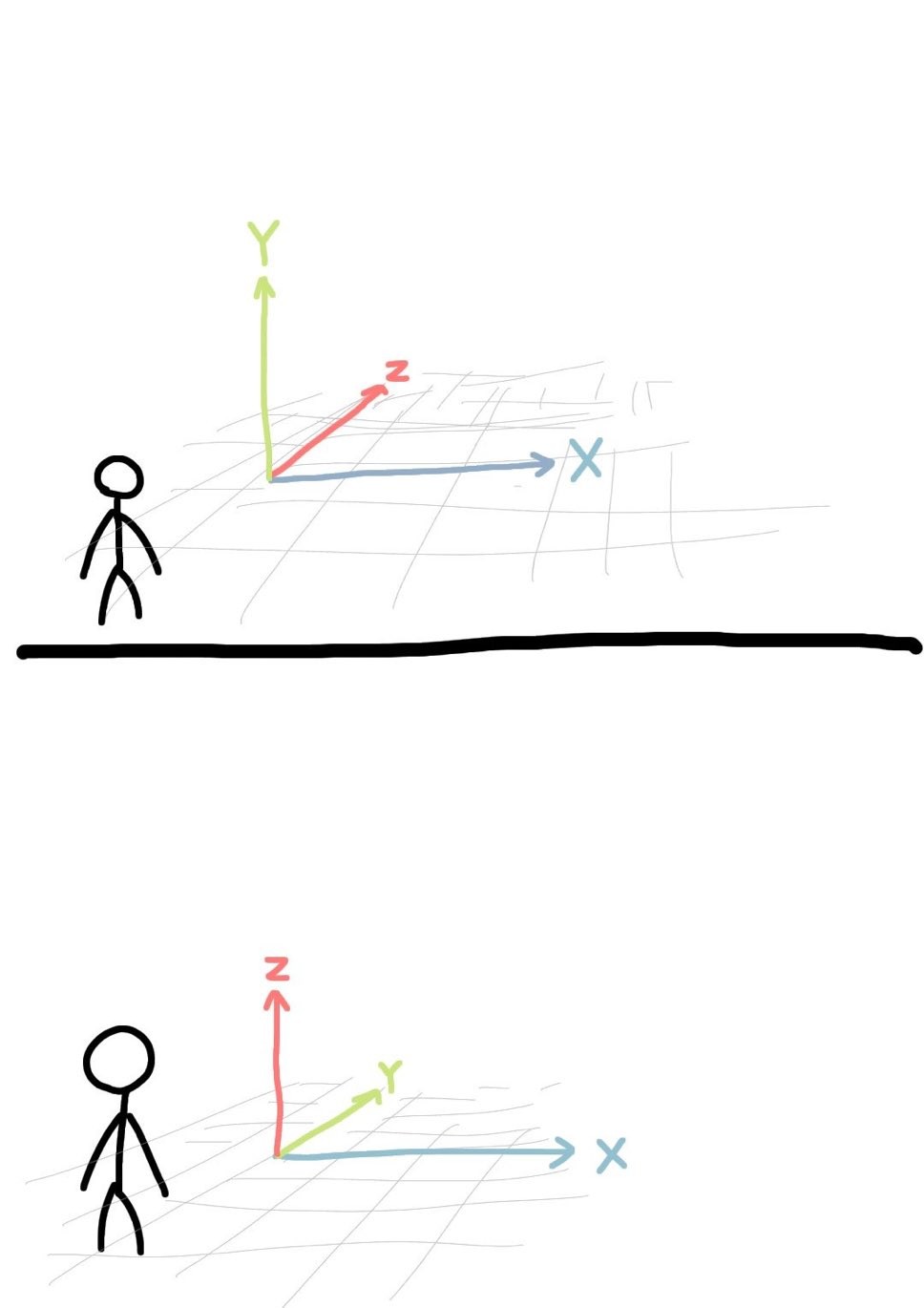
Y-up sorta makes sense in games. Imagine a 2D platformer, Y is up and X is horizontal. Now add depth. Instead of flipping axis just use Z for depth.
But in top down 2D games you also use X and Y but now neither is up
True but I think it’s also because of screen coordinates, Y is always the vertical axis in screen coordinates. So programmers translated that to 3D coordinates because in real world space the screen doesn’t lie flat but is up right. It’s probably why Y is up in OpenGL and calls the depth buffer the Z-Buffer.
That’s the core of my point though. Once you add depth it’s not 2d space anymore (even though the screen is 2d, the represented field is 3D) and y becomes depth.
It all depends how you perceive the XY plane. Like if your job involves blueprints than XY plane lies flat and horizontal then it makes sense that Z axis is height. Hence why engineering software is all Z-Up. If the XY plane is upright, like screen coordinates, then Z is depth. Hence why many software that is used to create content for the screen is Y-Up. Like Maya, Houdini, Unity, OpenGL etc.