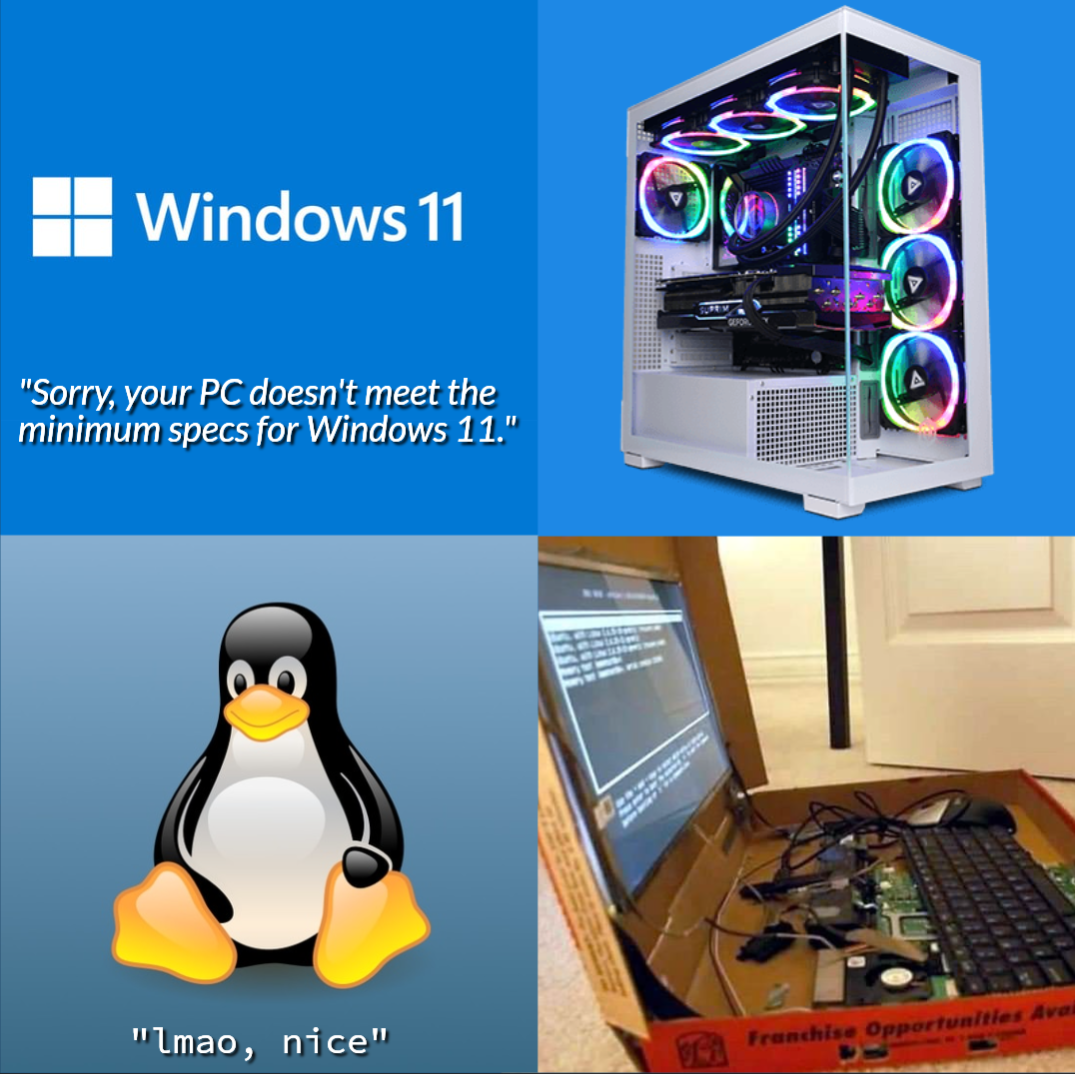

Before installing Linux, I had originally planned to dual-boot on my main PC, but somehow a gaming rig from 5 years ago isn’t good enough to run windows 11, which is ridiculous.
You must log in or # to comment.
Installed Fedora on my newish dell with intel integrated graphics. Watching videos in Firefox was nothing but lag, even in 720P.
And also when the lid is closed, it doesn’t go to sleep.
Linux is only good if you have some kind of driver support.
God, I love Linux nerds.
That is a glorious pizza box computer.
Tux: What 4 GB RAM? This is some gourmet shit.
Tell that to the modern web though.
Fuckin’ a man. My backup server uses 70mb of ram, My NAS, 250mb. My laptop, about 1GB doing normal usage things. Open up one webpage with a YouTube video embedded and the processor constantly runs all 4 cores at 30%+, fan is on high, 3GB ram getting eaten away at for a paused video and text. It’s ridiculous.
I don’t know how youtube does it, but decoding a video, say with libavcodec(ffmpeg) without GPU acceleration is pretty demanding. They could do it on their server and send you the stream, but then again they’d save a lot of money not doing that.
But I agree it shouldn’t take so much when nothing is happening, the web has very much become so bloated.
YouTube is so much less efficient than mpv for some reason, it’s goofy asf
True, but in the end it’s ffmpeg doing the work for both (at least on a linux system).
Someone got the link to the guy’s video installing windows 11 on a 2007 Sun Workstation by disabling the arbitrary checks?
Now genuinely curious, as an ex-Windows-refugee, how did the non-Windows-refugees, the “native” GNU/Linux users, find out about it?
Edit: BTW, started a journey with a laptop in a place with no internet. Luckily I had the foresight to install GNU/Linux on it before I started my journey. I was constantly reminded that I were in the same situation with Windows, the computer would stop working because it had no internet. You need internet for Microshit office, Adobe software, etc. That was the time I said: there has to be a better way. That’s when I started using free software. I’ll take the occasional, inadvertent usability annoyance with free software over the megacorporations trying to constantly gang rape me into submission any day.
I did come from Windows but the story wouldn’t change from anywhere else. The install CD was on a store shelf and I bought it.

A Celeron n4000 with only two cores, 4gb of DDR 3 RAM and 80gb sata I 5400rpm drive, that takes 25 minutes to boot: ✅ supported by Windows 11 because introduced on the market after 2018
A Xeon E7-8894 v4 with 24 cores, 3tb of ECC RAM and petabytes of nvme storage, paid $130k: ❌ unsupported by Windows 11 because introduced on the market before 2018
A totally valid way to define minimum requirements…
I am physicist and software engineer. My current Linux desktop PC is now 16 years old, from 2009, and with 8-core CPU and 16 GB RAM is still plain over-powered for running Emacs and rustc under Debian and Arch in VM. It is only the third desktop computer I own. I bought the second one in 1999, and that one had an AMD K6 (Pentium-like) CPU with 300Mhz clock, running S.u.S.E. Linux, and I used it for writing uni stuff and my PhD thesis on digital speech processing. The first PC I owned was a old PC with an Intel 80386 CPU which my uncle gave me in 1995. I could barely run Word 6.0 on Windows 3.11 on it (MS Word became very instable for larger documents), but LaTeX (emTeX) was running totally fine (after installing it from about 30 floppy disks).
So, to sum up: Using Linux you will save a ton of money for hardware.
I have a win10 PC with an extra hard drive on which I’ve installed Arch on. I’m thinking of deleting the Windows partition for extra storage on my Arch side because my CPU doesn’t support Win11, apparently. Is there anything I should be careful of before I go forward with my plan other than backing up data and the usual hardware compatibility issues when only using Linux?
Since you are already using arch I guess you kinda know what youre doing so you should be fine.
Haha, damn. Sorry.
I dunno why, but when I decided to try Linux six months ago, I just went with Arch and every other day I regret my choice. I’m too invested now and I do like tinkering.
Damn, that’s one hell of a learning curve. I struggled with doing the most basic stuff on Linux Mint. Theres no way I would have been able to handle arch as my first install.
If they stopped showing so many ads, maybe they’d leave enough memory to run an operating system.
I recently picked up a couple of e-waste laptops, Thinkpad x130e’s with an AMD E-300, 4GB RAM and a 320GB spinner. For the pair I paid $60 shipped. These were low-end semi-ruggedized laptops meant for students released around the time that HBO started showing Game of Thrones.
I’ve put Debian on one and it runs great. All the hardware just works, everything is pretty quick after boot, and I love how rugged and portable it is. Email, writing, basic productivity, hobby development and 2D gaming all work great. Web browsing takes a hit if I open too many tabs, the video card is too underpowered for most 3D games that came out after 2010, and large compiles are slow. I’m a bit worried about the aging HDD so I’m going to replace it with a cheap SSD which should help with boot and compile times.
The other one I’m not sure about. I’ve tried HaikuOS and the video and wifi work well and the whole system feels very snappy, but there’s no audio or webcam support. Redox seems interesting but needs a whole lot more hardware support. I’ll probably just end up cloning the first one unless I can get a better suggestion.
All that is to say, Linux is great on old cheap hardware.
Even the cheapest SSD you can find will improve the performance quite significantly.
i use some of those low power soc laptops, running with lid closed (heat is basically a non-issue), for pihole, white noise, and a few other ‘little’ things. one of 'em is even running stuff in VMs (the rest are debian-based dietpi).